There is a phrase from the popular Catholic press of the last century — its provenance disputed, frequently attributed to Bishop Sheen — to the effect that the Holy Mass is the most beautiful thing this side of heaven. The phrase has had a long life in homiletic literature, and a longer life in the mouths of priests teaching the young. When we set out to film a Solemn High Mass at Our Lady of Perpetual Help in the summer of MMXI, we did not labor over the title. The phrase named the thing we were attempting to record.
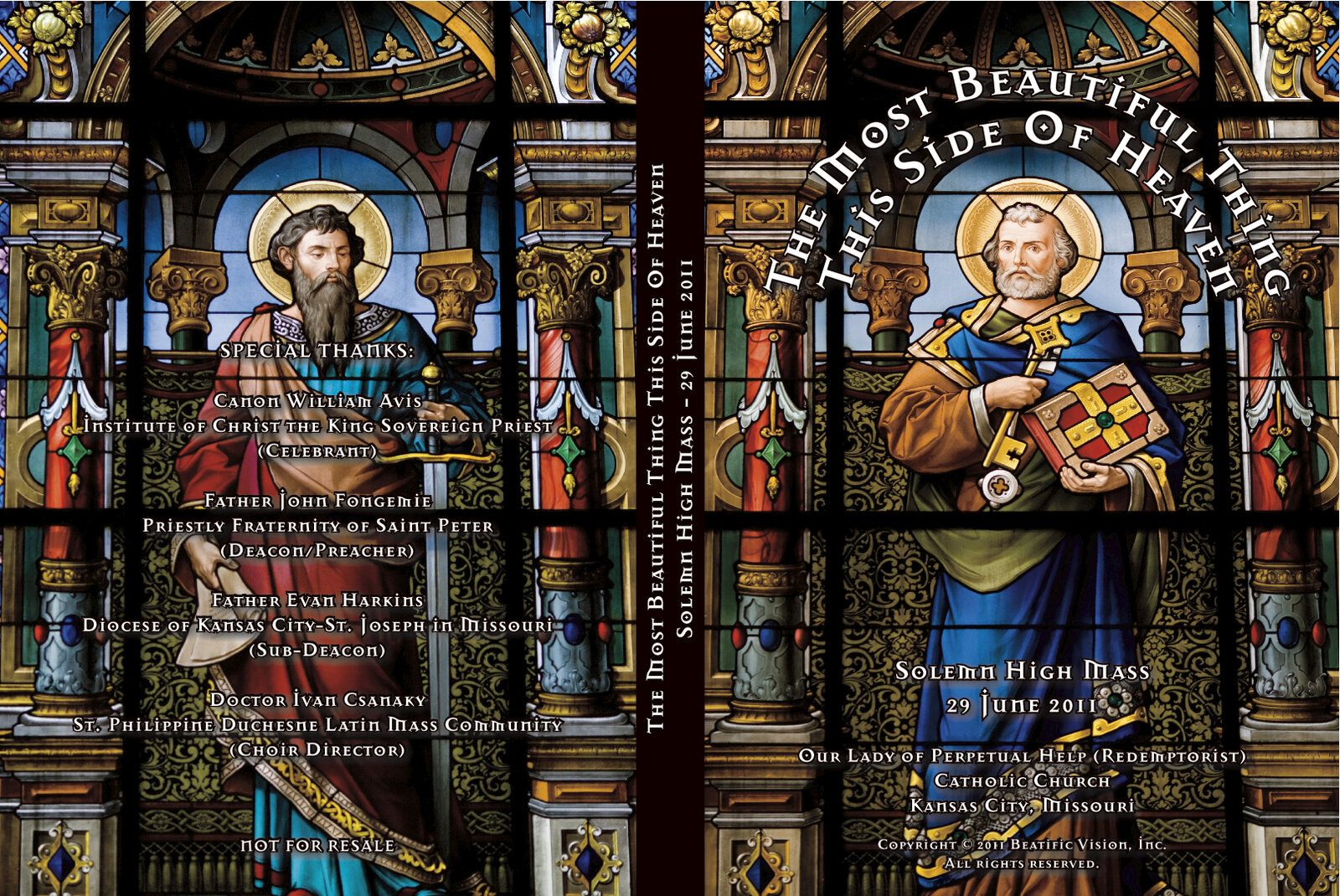
The Mass was offered on the twenty-ninth of June, MMXI, the Feast of Saints Peter and Paul, in the church of Our Lady of Perpetual Help in Kansas City, Missouri — the Redemptorist parish, named locally for its shrine to the eponymous icon.
- Celebrant
- Canon William Avis — Institute of Christ the King Sovereign Priest
- Deacon & Preacher
- Father John Fongemie — Priestly Fraternity of Saint Peter
- Sub-Deacon
- Father Evan Harkins — Diocese of Kansas City–Saint Joseph in Missouri
- Choir Director
- Doctor Ivan Csanaky — Saint Philippine Duchesne Latin Mass Community
Three jurisdictions of priestly life, gathered at one altar, on one feast, for one Mass. The fact itself was a small marvel. We did not arrange it; the circumstances did.
The film's subject is what was happening, in those years, beneath the visible surface of Catholic life in middle-American dioceses: the patient, parochial, often under-publicized work of returning the Traditional Latin Mass to a place of regular and dignified celebration in mainstream parishes. Nothing about the Kansas City story was unique. That is precisely why we wanted to film it. What was happening in our diocese was happening in dozens of others — and would soon be happening in hundreds more — and almost no one was making a sustained visual record of any of it.
The documentary runs sixty-four minutes. It is patient. It does not preach. It frames the rite, the music, the ministers, the people in the pews, and it allows the Mass to make its own argument. The argument the Mass makes — when it is permitted to be itself, in the form the Church has handed down — is the argument the title makes. We are not philosophers in this; we are, at most, attentive recordists. The phenomenon is its own apologist.
In MMXI, the film was released on DVD, distributed in modest quantities, and screened in small parish settings. The original masters were preserved. For more than a decade they sat — through a season of legal practice, the formation of a family, the deliberate setting-aside of the studio — in the keeping of a director who never stopped intending to bring them out again.
We have brought them out.
The Most Beautiful Thing This Side of Heaven is being restored from the original masters and re-released in MMXXVI as the inaugural feature of the resumed Beatific Vision catalog. It is the same film. The choices are the same choices. The framing is the framing we made at twenty-eight. The benefit of the years is in the housing — a proper streaming platform, a proper application, a proper studio architecture — not in the editorial.
When the film opens on the platform — within the week of this note — viewers will encounter the Mass as our young camera crew first encountered it: in awe, at a respectful distance, with a willingness to be silent for long stretches and let the chant speak. We had little in the way of resources. We had a Canon body, a tripod, a few lavalier microphones, the goodwill of the celebrants, and the obvious truth that we were filming something that did not need our embellishment.
It needed, only, to be seen.
A note, finally, of gratitude. To Canon Avis, Father Fongemie, Father Harkins, and Doctor Csanaky — and to the Redemptorist Fathers of Our Lady of Perpetual Help, who hosted the Mass and the cameras alike. To the choir, the servers, and the parishioners of that morning. Without them there is no film, because without them there is no Mass.
To the Mass itself: the most beautiful thing this side of heaven.