In the spring of MMXI, Beatific Vision launched the Seraphim Screenwriting Competition: the first nationwide Catholic screenwriting contest, advertised in the trade press, offering a guaranteed five-thousand-dollar prize and — what no studio in our memory had then offered — a guaranteed greenlight. The winning script would be developed and produced. Not optioned and shelved. Not workshopped indefinitely. Made.
The advertisements ran in Script Magazine and Creative Screenwriting, the two principal screenwriting trade publications of the era. The print files were prepared in late MMX and the placement followed in the trade press of MMXI. The contest opened the first of January and closed the first of June. Submissions arrived from across the country and from a few correspondents abroad. The mailing address was a post-office box in Lee's Summit, Missouri. The prize was real. The intent was real. The mark — BEATIFIC VISION™ · LUMEN GLORIAE — appeared in print, in commerce, in the trade press of an industry from which serious Catholic creative work had long been formally absent.
We did not award the grand prize.
The contest's stated terms were precise: were the in-house team to find no script suitable for the five-thousand-dollar commitment and the production guarantee, the company would neither be bound to declare a winner nor to award prize money. The submissions were earnest, several of them quite moving. None met the threshold a fledgling studio could responsibly underwrite. The decision was disappointing — to the entrants, to us — but it was correct. A guaranteed greenlight is not a marketing line. It is a fiduciary commitment.
The competition did, however, succeed in three ways its public face could not anticipate.
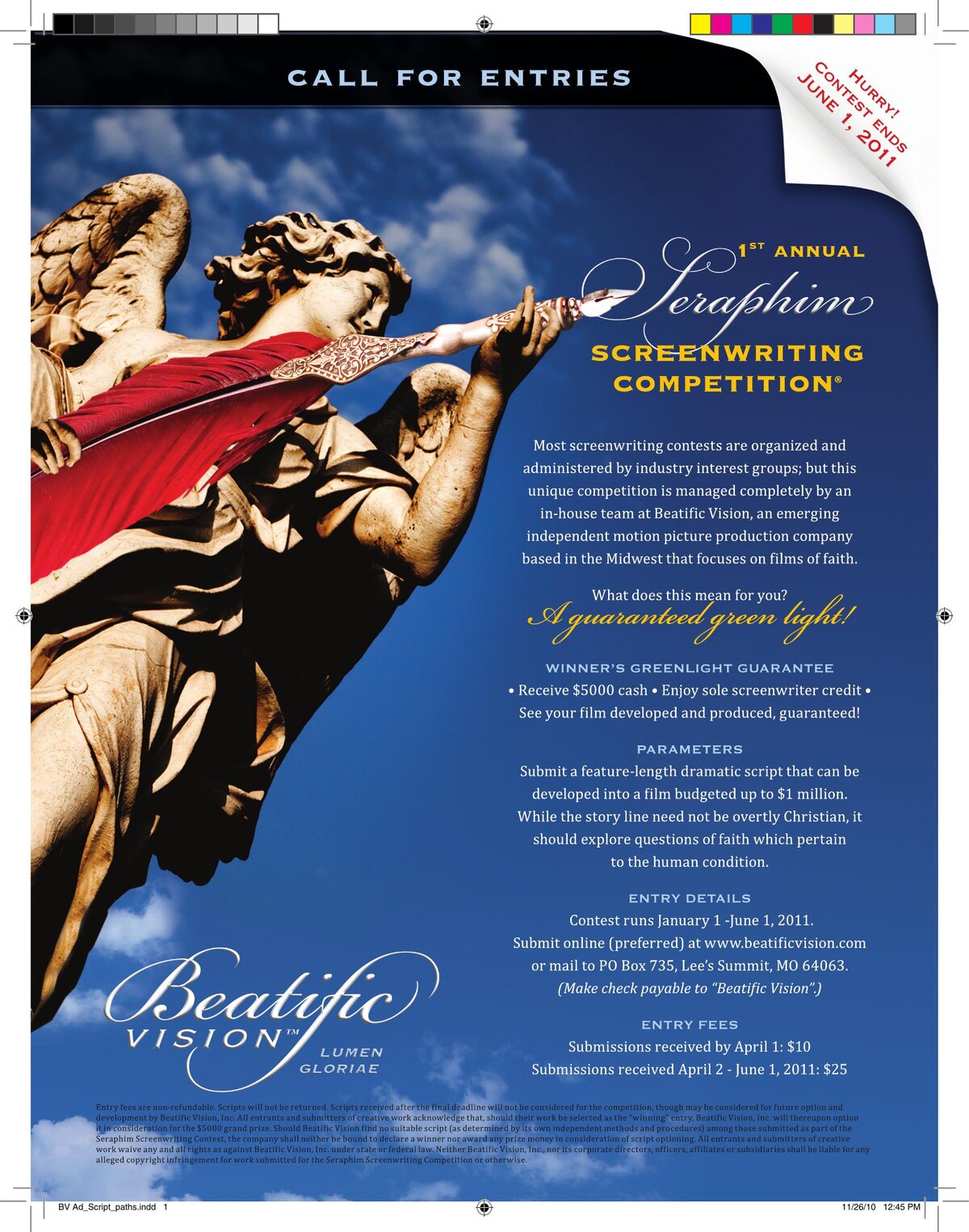
First, it established prior use of the Beatific Vision mark in commerce — in the trade press, with paid placement, in interstate distribution — at a moment many years before the marks were formally registered with the United States Patent and Trademark Office. The advertisement reproduced below is, among other things, a primary-source artifact of that use.
Second, it taught the company a great deal about the thinness of the Catholic dramatic-script pipeline as it then stood, and about how much foundational work was required upstream of any contest, any studio, any production guarantee. You cannot greenlight what has not been written. You cannot commission what has not been formed. The Seraphim experiment is, in a sense, the proximate cause of the Catholic Film Institute, which exists to do the formation work — to train, to fund, to mentor, to commission — at a scale the contest model alone could not.
Third, it taught us patience.
The form is right; the moment is more receptive; the infrastructure now exists, in the Catholic Film Institute, to do the upstream work the first attempt could not. When the announcement comes, it will come with a script we are confident we can produce, and a slate behind it.
The advertisement reproduced here ran in the trade press of MMXI. The graphic shows a sculpted angel — drawn from the great Roman tradition of bridge-and-portico statuary — rendered against an open sky. The mark is visible at the lower left in our then-and-now wordmark, with the motto LUMEN GLORIAE — the light of glory — a phrase from the scholastic theology of the beatific vision itself. The rough edges of an early mark do not embarrass us. They are the marks of an honest beginning.
What we did then we did imperfectly. What we are doing now we are doing with the benefit of the lesson. A studio, as the cathedrals taught, is not an event. It is a tradition. It builds.